In recent years, growing attention has been paid to indoor air quality (IAQ) as a determinant of health and productivity. As most people spend up to 90 percent of their time indoors, in homes, offices, and public buildings, exposure to airborne pollutants within these environments has become a major public health concern [1]. Among these, formaldehyde is one of the most common and well-studied volatile organic compounds (VOCs) emitted from building materials and furnishings.
At DVS Holdings, we believe that sustainability and well-being begin with the materials that shape our spaces. Understanding what formaldehyde is, where it comes from, and how to minimise exposure through material selection is crucial to designing healthier workplaces.
Formaldehyde (CH₂O) is a colourless, pungent gas that is widely used in industrial and manufacturing processes. In furniture, it is commonly released as an off-gas from adhesives, resins, and coatings used in wood-based materials.
According to the International Agency for Research on Cancer (IARC), formaldehyde is classified as a Group 1 carcinogen, meaning there is sufficient evidence that it can cause cancer in humans [2]. Long-term exposure has been linked to nasopharyngeal cancer, leukemia, and chronic respiratory symptoms [3, 4]. Even at lower concentrations, short-term exposure may cause eye, nose, and throat irritation, coughing, or headaches [5].
Indoor formaldehyde concentrations can be higher than outdoor levels, particularly in newly renovated spaces or those with limited ventilation. The compound’s emission rate is also influenced by temperature and humidity, meaning poorly ventilated and humid conditions can amplify exposure risk [6].
This is especially pertinent in Singapore’s climate, where humidity can remain high throughout the year, increasing the potential for off-gassing in enclosed spaces.
Most wood-based furniture, such as tables, cabinets, and partitions, uses engineered wood products like particleboard, medium-density fibreboard (MDF), and plywood. These materials are made by binding wood particles or fibres together with adhesives, many of which are based on urea-formaldehyde (UF), melamine-formaldehyde (MF), or phenol-formaldehyde (PF) resins.
While these resins provide durability, water resistance, and affordability, they are also the primary sources of formaldehyde emissions indoors [6]. Emissions are highest when furniture is new and gradually decrease over months or years as the material cures and off-gasses.
To address this issue, international standards and material innovations have been introduced to reduce emissions, leading to the development of E-graded boards.
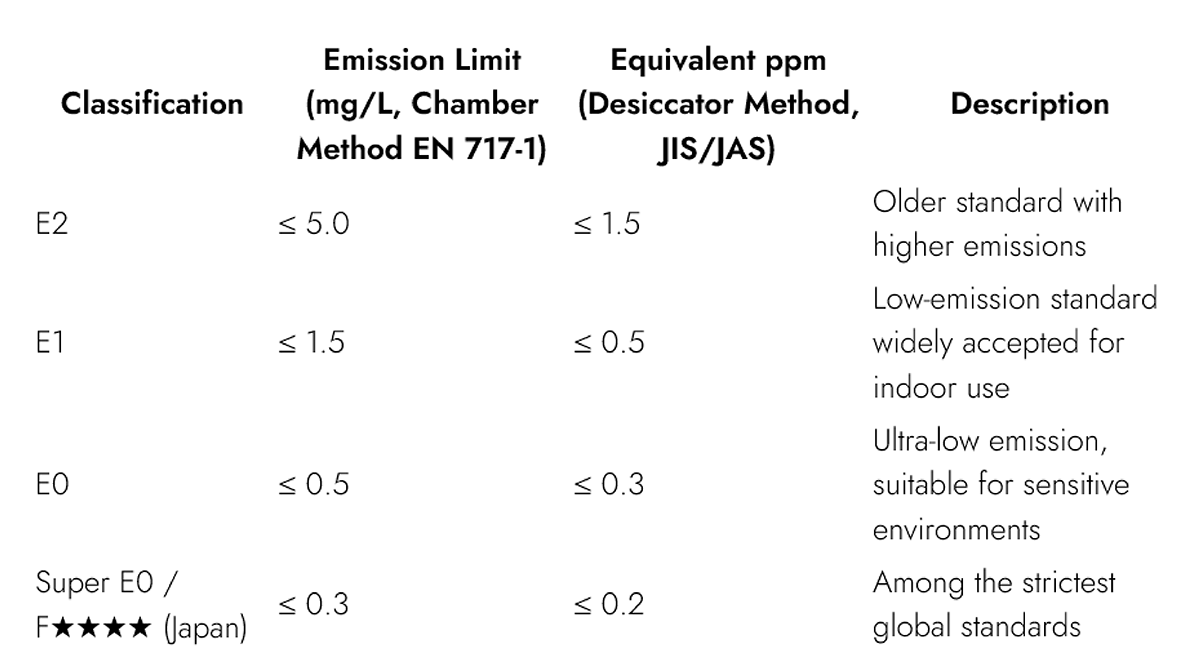
The E-rating system, commonly used in Europe and Asia, classifies boards according to their formaldehyde emission levels.
In essence, the lower the E-rating number, the cleaner the board. For comparison, the California Air Resources Board (CARB) Phase 2 and United States EPA TSCA Title VI standards are roughly equivalent to E1 levels [7].
E0 boards often use modified or alternative resins, such as phenol-formaldehyde or no-added-formaldehyde (NAF) adhesives based on soy or polymeric methylene diphenyl diisocyanate (pMDI). These reduce emissions while maintaining strength and stability.
Clients looking to improve indoor air quality should therefore specify E0 or E1 materials in renovation or refurbishment projects. DVS offers a comprehensive range of low-emission boards; indeed, our furniture is typically produced using E1-grade boards, which already meet stringent international standards for indoor use and safety. For clients who require even stricter specifications, E0-grade materials are also available upon request.
Breathable Mesh and Upholstery
Thermal comfort and microclimate control play an underappreciated role in ergonomics. Mesh backrests improve heat dissipation and moisture regulation, while contoured foam or fabric surfaces distribute pressure evenly, reducing discomfort and restlessness [20].
In Singapore’s tropical climate, breathable materials such as mesh offer a cooler, longer-lasting seating experience without compromising structural support.
Base Stability and Mobility
A five-point base enhances balance and prevents tipping during movement. Casters should be matched to flooring type — hard casters for carpeted surfaces, soft polyurethane casters for hard floors — to ensure smooth motion and prevent strain from forced adjustments.
At DVS Holdings, we recognise that every workspace tells a story not only of design and function but also of responsibility. In line with our mission of Reimagining Space, we have made conscious decisions in sourcing materials that prioritise both performance and health.
These efforts align with our broader sustainability approach, which also includes responsibly sourced materials and modular designs that extend furniture lifespan. More about this approach can be found under our Sustainability page
While material selection plays a key role, air circulation, humidity control, and maintenance also influence indoor air quality. DVS encourages clients to complement low-emission furniture with adequate ventilation, routine cleaning, and green-certified paints or carpets.
Designers and facility managers can also look for certifications such as Singapore Green Label, GREENGUARD Gold, or LEED, which integrate low-VOC and IAQ considerations into overall project design.
When specifying furniture, consider integrating low-emission boards with DVS’s ergonomic solutions such as the Altimate height-adjustable series. These solutions enhance user comfort and health by promoting better posture and air circulation within the workspace.
The pursuit of cleaner and healthier indoor environments begins with informed choices. Formaldehyde emissions remain a significant yet manageable aspect of modern furniture production. Through responsible material selection such as E0 and E1 boards, manufacturers like DVS Holdings are helping redefine what it means to create safe, inspiring, and sustainable spaces for work and life.
‘Space Reimagined’ is not only a slogan but a reflection of our ongoing commitment to rethink how materials, design, and health intersect to shape the future of work.
[1] Mendell, M. J., & Mirer, A. G. (2008). Indoor thermal factors and symptoms in office workers: Findings from the US EPA BASE study. Indoor Air, 18(4), 301–316. https://doi.org/10.1111/j.1600-0668.2008.00530.x
[2] International Agency for Research on Cancer (IARC). (2012). IARC Monographs on the Evaluation of Carcinogenic Risks to Humans, Volume 100F: Chemical Agents and Related Occupations. Lyon, France: World Health Organization.
[3] Hauptmann, M., Lubin, J. H., Stewart, P. A., Hayes, R. B., & Blair, A. (2004). Mortality from lymphohematopoietic malignancies among workers in formaldehyde industries. Journal of the National Cancer Institute, 96(21), 1615–1623. https://doi.org/10.1093/jnci/djh290
[4] Zhang, L., Steinmaus, C., Eastmond, D. A., Xin, X. K., & Smith, M. T. (2009). Formaldehyde exposure and leukemia: A new meta-analysis and potential mechanisms. Mutation Research/Reviews in Mutation Research, 681(2–3), 150–168. https://doi.org/10.1016/j.mrrev.2008.07.002
[5] World Health Organization. (2010). WHO Guidelines for Indoor Air Quality: Selected Pollutants. Geneva, Switzerland: WHO Regional Office for Europe.
[6] Salthammer, T., Mentese, S., & Marutzky, R. (2010). Formaldehyde in the indoor environment. Chemical Reviews, 110(4), 2536–2572. https://doi.org/10.1021/cr800399g
[7] California Air Resources Board (CARB). (2008). Airborne Toxic Control Measure to Reduce Formaldehyde Emissions from Composite Wood Products. Sacramento, CA: California Environmental Protection Agency.